How to Host a Backyard Game Tournament Your Friends Will Talk About All Year
You’ve got the games. You’ve got the yard. You’ve got people who love friendly competition. It’s time to stop playing random pickup games and turn your backyard into a proper tournament venue.
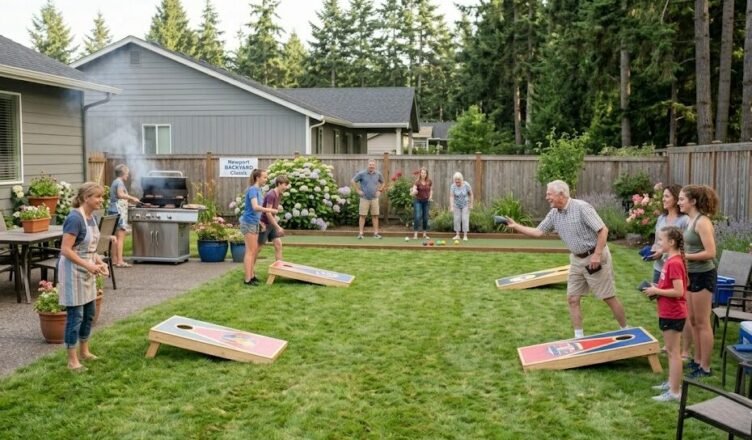
A well-organized backyard tournament is the kind of event that becomes an annual tradition. People show up early, stay late, and text you for months asking “when’s the next one?” The trick is getting the right balance of competition and fun — organized enough to feel legitimate, casual enough that everyone has a great time regardless of skill level.
This guide covers everything you need to host a tournament that actually works — from choosing the right games and format to managing brackets, feeding people, and keeping the energy up all day.
Step 1: Pick Your Games
The games you choose set the tone for the entire event. Here’s how to think about it:
Single-game tournament (simplest): Pick one game and run a full bracket. Cornhole is the most popular choice because everyone knows the rules and skill levels vary enough to keep things interesting. See our complete guide to running a cornhole tournament for cornhole-specific details.
Multi-game tournament (most fun): Set up 3-5 different games as “stations” and have teams rotate through all of them. Total scores across all games determine the overall winner. This format keeps things fresh and prevents any one player’s strength from dominating. It also means you need more equipment but get more variety.
Best games for tournaments:
| Game | Players Per Match | Space Needed | Round Time | Tournament Suitability |
|---|---|---|---|---|
| Cornhole | 2-4 | 35 feet | 15-20 min | Excellent — the tournament standard |
| Bocce | 2-8 | 30-60 feet | 15-20 min | Great — flexible group sizes |
| Ladder Toss | 2-4 | 15 feet | 10-15 min | Great — fast rounds, easy rotation |
| Horseshoes | 2-4 | 40 feet | 15-20 min | Good — classic tournament game |
| KanJam | 4 | 50 feet | 10-15 min | Good — high energy team play |
| Giant Jenga | 2-10+ | Minimal | 5-10 min | Fun side event, not bracket-worthy |
| Spikeball | 4 | 20×20 feet | 10-15 min | Great for athletic groups |
Our recommendation for a multi-game tournament: Cornhole + bocce + ladder toss. Three different game types (tossing, rolling, wrapping), similar round times, and manageable space requirements. Add a fourth game if you have enough equipment and space.
Step 2: Choose Your Format
The right format depends on how many players you have and how competitive you want things to be.
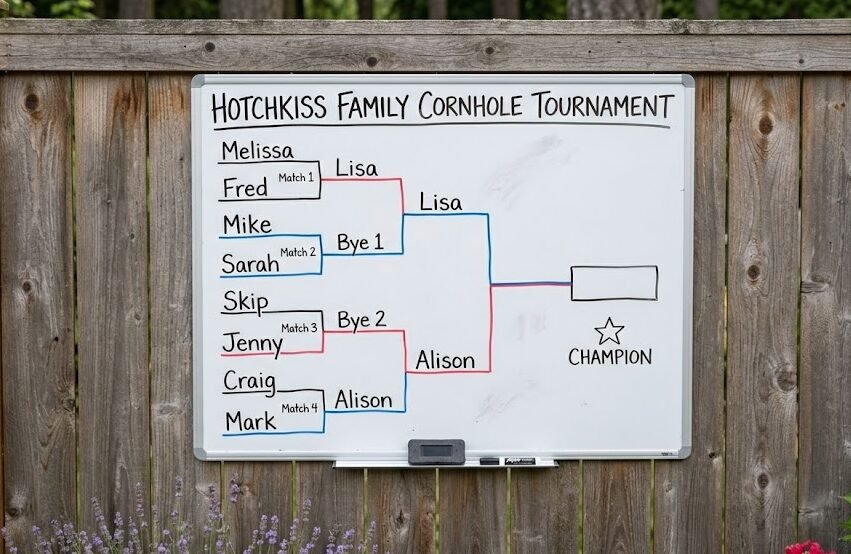
Single Elimination
How it works: Lose once and you’re out. Winners advance until one team remains. Best for: 8-16 teams, when time is limited, competitive groups. Pros: Simple, fast, dramatic finishes. Cons: Half your players are eliminated after round one. People who came to play might only get one game. Tip: Run a consolation bracket so eliminated teams still have something to play for.
Double Elimination
How it works: You have to lose twice to be eliminated. After your first loss, you drop to the “losers’ bracket” and fight your way back. Best for: 8-16 teams, groups that want more playing time, competitive tournaments. Pros: Everyone plays at least twice. More fair than single elimination. Cons: Takes longer. Bracket management gets complicated.
Round Robin
How it works: Every team plays every other team. Most wins at the end takes the title. Best for: 4-8 teams, casual tournaments, when you want maximum playing time. Pros: Everyone plays a lot. Most fair format. Great for social events. Cons: Takes the longest. Can feel less dramatic without a “final” match. With many teams, scheduling gets complex. Tip: Follow the round robin with a playoff bracket (top 4 teams) for a dramatic finish.
Multi-Game Points System
How it works: Teams rotate through multiple game stations, earning points at each one. Total points across all games determine the overall champion. Best for: 4-12 teams, multi-game events, mixed skill levels. Pros: No one is eliminated. Every game matters. Rewards well-rounded teams over specialists. Cons: More complex scoring. Needs someone dedicated to tracking points. Scoring example: 1st place at a station = 10 points, 2nd = 7, 3rd = 5, 4th = 3, 5th+ = 1.
Step 3: Set Up Your Yard
Think of your yard as a venue. A little planning makes the day run dramatically smoother.
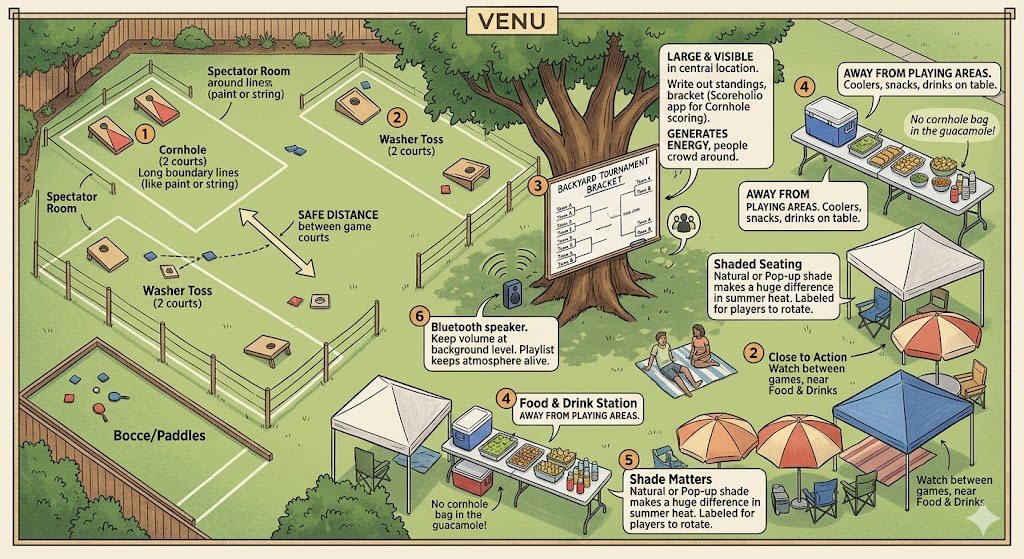
Game stations: Space games far enough apart that throws, rolls, and discs from one game don’t interfere with another. Each station should have clear boundaries and enough room for spectators.
Spectator zone: Set up chairs, blankets, or a shaded area where people can watch between games. Near the food and drinks is ideal. People who aren’t playing should still feel like they’re part of the event.
Scoreboard/bracket display: A large whiteboard, chalkboard, or poster board in a central visible location. Write out the bracket or standings where everyone can see it. This single item generates more tournament energy than anything else — people crowd around it after every match. For cornhole-specific scoring, the Scoreholio app is excellent.
Food and drink station: Away from the playing areas. Nobody wants a cornhole bag landing in the guacamole. A folding table or two with coolers, snacks, and drinks is all you need.
Shade matters. If your yard doesn’t have natural shade, a pop-up canopy or two for the spectator/food area makes a huge difference in summer heat. Players will rotate through shade between matches.
Sound. A Bluetooth speaker with a playlist keeps the atmosphere alive between games. Keep the volume at background level — loud enough to create atmosphere, quiet enough that people can talk.
Step 4: Handle the Details
Invitations and Teams
Send invitations 2-3 weeks in advance. Include the date, time, what games you’ll play, and whether people need to bring anything (chair, dish to share, etc.). A group text, Facebook event, or even a free Evite works fine.
Team formation options:
- Bring Your Own Partner: Players sign up as pre-made pairs. Works for competitive tournaments.
- Random Draw: Pull names from a hat at the event. Creates unexpected pairings and levels the playing field. More social and more fun for casual events.
- Draft: The two highest-ranked players take turns picking partners. Creates balanced teams and adds a fun draft-night element.
Plan for 8-16 teams. Fewer than 8 feels too small. More than 16 gets hard to manage without dedicated organizers.
Timing
Start mid-morning or early afternoon. A 10 AM or noon start gives you plenty of daylight. Plan for 3-5 hours depending on format and number of teams. Account for slower rounds than expected — things always take longer than you think.
Build in breaks. A 15-20 minute break between the preliminary rounds and the finals lets people eat, hydrate, and build anticipation. Use this time for a raffle, a skill contest (longest cornhole shot, most ringers), or just socializing.
Food and Drinks
Keep it simple. Tournament food should be easy to eat standing up, not require utensils, and survive sitting out in warm weather:
- Burgers, hot dogs, brats (grill between managing the bracket)
- Chips, pretzels, trail mix
- Fruit (watermelon is the king of backyard tournament food)
- Cooler full of water, sports drinks, and whatever else your crowd enjoys
- Ask guests to bring a dish or a 6-pack to share — potluck style reduces your workload and cost
Step 5: Prizes and Awards
Prizes elevate a casual game day into a real tournament. They don’t need to be expensive — the best tournament prizes are memorable, not valuable.
Prize ideas:
- Cheap trophy or medal from Amazon ($10-$15 for a set). The sillier the better — people display these proudly.
- Gift card to a local restaurant or brewery ($25)
- The right to display the trophy until next year’s tournament (traveling trophy tradition)
- Custom champion T-shirts or hats (if you want to go all out)
- Winner gets to pick the first game at next year’s tournament
- Bragging rights (free, and often the most valued prize of all)
Fun awards beyond first place:
- Best Comeback: Team that recovered from the worst deficit
- Best Sportsmanship: Voted by players
- Worst Throw of the Day: Embrace the fails — award the most spectacularly bad throw
- MVP: Best individual performance across all games
- Loudest Fan: Best spectator energy
- Last Place Trophy: A gag trophy for the team that finished last (make it funny, not mean)

Step 6: Keep the Energy Up
The difference between a great tournament and a forgettable one is energy management. Here’s how to keep things fun from start to finish:
Start with an easy game. If you’re running multiple games, begin with the most accessible one (ladder toss or cornhole). Save the physically demanding or complex games for later when people are warmed up.
Keep downtime short. The biggest tournament killer is waiting. If teams are sitting around between matches, they lose interest. Run multiple games simultaneously if you have the equipment. Post the next matchup while the current one is still finishing.
Announce everything. Call out match results, upcoming matchups, and standings updates out loud. This creates a shared experience even for people who aren’t currently playing. A tournament without commentary is just people playing games near each other.
Music between matches. Fill the gaps with music. It prevents awkward silence and maintains party atmosphere.
The finals should feel special. If possible, have everyone gather around for the championship match. Build it up. Introduce the teams. This is the moment people remember.
Multi-Game Tournament: Sample Schedule
Here’s a ready-to-use schedule for a 3-game, 8-team tournament:
12:00 PM — Welcome, team assignments (random draw), rules review 12:15 PM — Round 1: All teams play cornhole (4 matches on 2 boards) 1:00 PM — Round 2: All teams play bocce (4 matches) 1:45 PM — Break — eat, socialize, update standings 2:15 PM — Round 3: All teams play ladder toss (4 matches) 3:00 PM — Tally total points, announce top 4 teams 3:15 PM — Semifinals: Top 4 teams play cornhole (winner’s choice of game also works) 3:45 PM — Championship match — everyone watches 4:00 PM — Awards, photos, bragging
Total time: About 4 hours. Adjust based on your group size and game count.
Frequently Asked Questions
How many people do I need for a backyard game tournament? A minimum of 8 people (4 teams of 2) makes a viable tournament. The sweet spot is 12-16 people (6-8 teams). More than 20 starts requiring significant organization and multiple game sets running simultaneously.
What’s the best game for a backyard tournament? Cornhole is the most popular tournament game because nearly everyone knows the rules, matches are quick, and it works for all skill levels. For multi-game tournaments, combine cornhole with bocce and ladder toss for the best variety.
How long does a backyard tournament take? A single-game, single-elimination tournament with 8 teams takes about 2 hours. A multi-game tournament with round robin play takes 3-5 hours. Always plan for more time than you think — rounds run long, breaks happen, and socializing fills gaps.
Do I need to buy special equipment? You need enough game sets to keep matches moving. For cornhole, one set works for up to 8 teams (matches take 15-20 minutes). For faster rotation, two sets let you run simultaneous matches. For multi-game tournaments, you need one set of each game. Check our guides for cornhole, bocce, ladder toss, and horseshoes.
What if it rains? Have a rain date planned and communicate it with your invitations. If rain threatens, move what you can under covered areas (garages, covered patios). Cornhole and ladder toss can work under cover. Giant Jenga works in a garage. If all else fails, postpone — a rain-soaked tournament is no fun for anyone.
Already running cornhole tournaments? Check out our Complete Cornhole Tournament Guide and How to Start a Cornhole League. Need equipment? Visit our Backyard Games hub for guides on every game.
This post contains affiliate links. When you purchase through our links, we earn a small commission at no extra cost to you. For more details, see our Affiliate Disclaimer.