
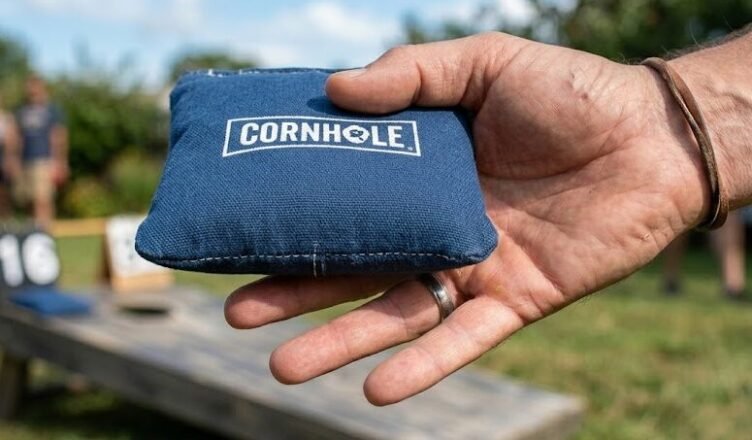
Most people learn cornhole by just chucking bags at the board and hoping for the best. And honestly, that works fine for casual play. But if you’ve ever watched someone who really knows what they’re doing — bags sliding perfectly into the hole, throws landing in the exact same spot every time — you know there’s a big gap between “playing cornhole” and “being good at cornhole.”
The good news: cornhole isn’t complicated. There are a handful of fundamentals that, once you get them down, will dramatically improve your accuracy and consistency. You don’t need to be athletic. You don’t need to practice for hours. You just need to understand the mechanics and repeat them.
This guide covers everything from basic grip and stance to advanced shots like airmails and pushes. Whether you’re a total beginner or a league player looking to sharpen your game, there’s something here for you.
The Fundamentals: Get These Right First
Before worrying about advanced shots or competitive strategy, nail these five basics. They’re the foundation that everything else builds on.
1. Grip
How you hold the bag determines how it flies. The goal is a grip that lets the bag release flat and spinning — like a frisbee, not a baseball.
The standard grip: Lay the bag flat on your open palm, fingers underneath, thumb on top gripping about halfway down the opposite edge. Your palm should face upward toward the sky throughout your throw. This is how most competitive players hold the bag.
Don’t squeeze. A death grip on the bag creates tension in your hand and forearm, which makes your release inconsistent. Hold it firm enough that it won’t slip, but loose enough that your hand stays relaxed.
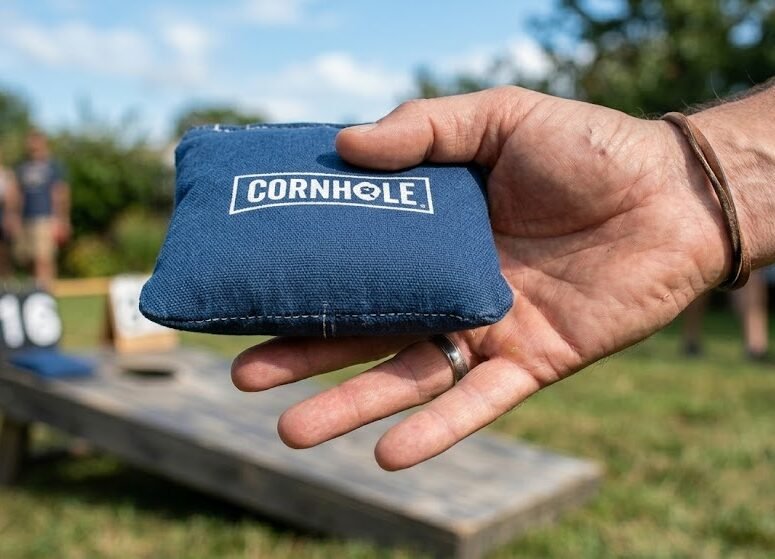
Finding your grip: Try sliding your thumb position around — closer to the edge gives more spin, closer to the center gives more control. There’s no single “correct” grip. The right grip is the one that gives you the most consistent flat release. Experiment during practice, then stick with what works.
2. Stance
Your lower body provides the foundation for your throw. An unstable stance means an inconsistent throw, no matter how good your arm mechanics are.
Basic stance: Stand with your feet roughly shoulder-width apart. If you throw right-handed, your left foot should be slightly forward (opposite for lefties). Keep your weight balanced and your knees slightly bent.
The step approach: Many players take a small step forward with their lead foot as they throw, transferring their weight from back foot to front foot. This generates a little momentum and creates a rhythmic motion that improves consistency. Think of it like a bowling approach — smooth and controlled.
Find your spot: In competitive play, you must throw from behind the foul line (the front edge of the board nearest to you). Most players stand right next to the board, either with their throwing arm directly over the board or just outside it. Try both positions and see which gives you a more natural arm path to the target.
The most important thing about stance: be consistent. Stand in the same spot, the same way, every single throw. Consistency in your lower body lets you focus on aiming rather than re-finding your balance.
3. The Throw
The throwing motion is an underhand swing — similar to bowling or slow-pitch softball. Your arm is a pendulum swinging from the shoulder.
The motion: Start with the bag at your side or slightly behind you. Swing your arm forward smoothly, releasing the bag as your hand passes your hip and rises toward waist height. Follow through with your arm continuing upward, finishing with your hand pointing toward the target at about head height.
Key points:
- Only your shoulder and wrist should be moving. Keep your elbow relatively stable — don’t bend and extend it like a catapult.
- Your palm should face the sky throughout the throw and at the release point.
- The follow-through matters. Don’t stop your arm after release. Let it continue naturally upward. A cut-off follow-through creates inconsistency.
4. Release Point
Where you let go of the bag determines where it goes. This is the most critical moment of the throw.
Consistency is everything. Release at the same point in your arm swing every time. For most players, this is just above waist height as the arm swings past the hip. Your index and middle fingers should be the last part of your hand touching the bag — this naturally creates the flat spin you want.
Common mistake: Releasing too late (above shoulder height) sends the bag too high and too far. Releasing too early (below the hip) sends it too low and too short. The sweet spot is right around waist height.
5. Arc and Spin
The bag should fly in an arc — not a line drive and not a moonball. After a little practice it will become pretty clear what works and well…what does not!
Ideal arc: The peak of the bag’s flight should be about 7-10 feet off the ground. This gives the bag enough height to land softly on the board rather than slamming into it and bouncing off. Think of it like a basketball free throw — a smooth, predictable arc.
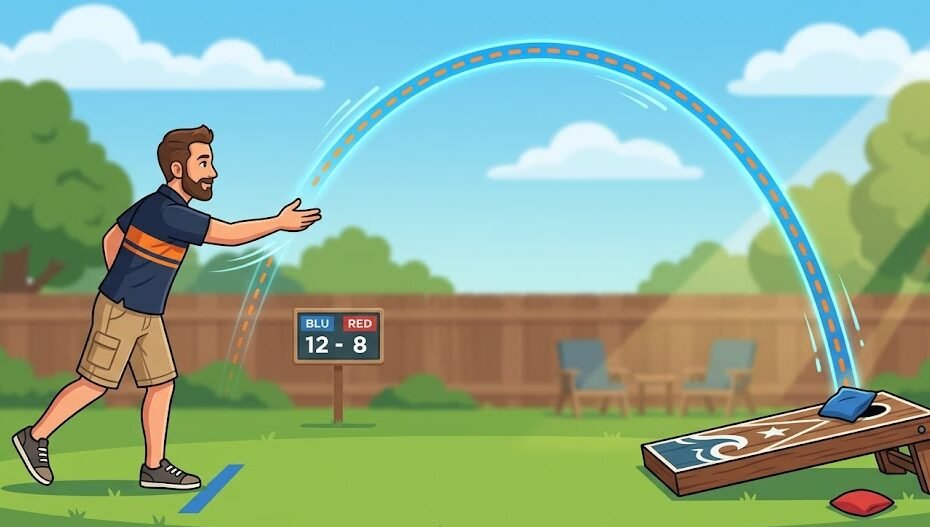
Flat spin: The bag should rotate flat (like a frisbee) as it flies. A flat-spinning bag lands predictably and slides consistently. A bag that tumbles or flips in the air will land unpredictably. The flat spin comes naturally from the grip and release — if your palm faces up and your fingers roll off the bag at release, the spin takes care of itself.
Where to Aim
This is where most beginners go wrong. Your instinct says “aim for the hole.” But that’s actually not the best strategy until you’re very consistent.
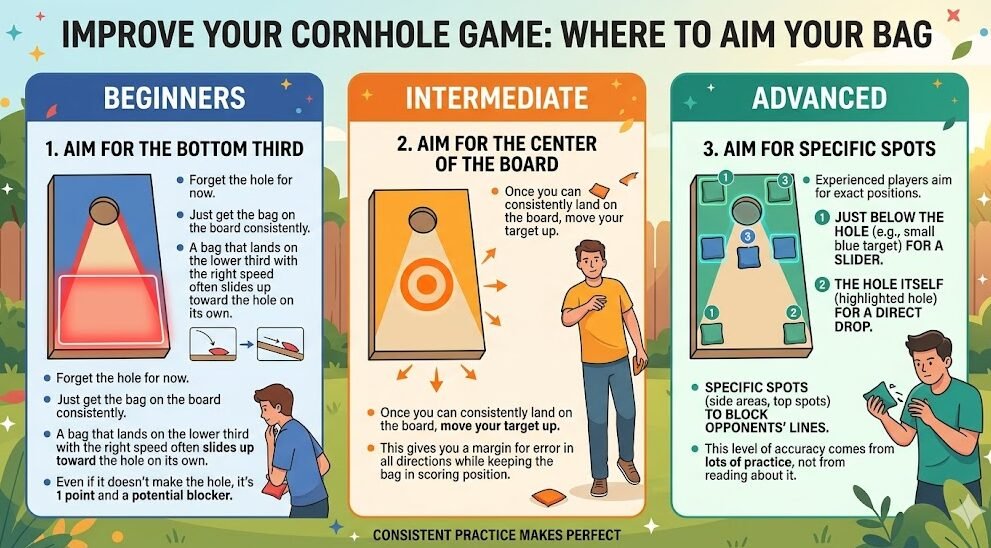
Beginners: Aim for the bottom third of the board. Forget the hole for now. Just get the bag on the board consistently. A bag that lands on the lower third of the board with the right speed will often slide up toward the hole on its own. Even if it doesn’t make the hole, it’s 1 point and a potential blocker.
Intermediate: Aim for the center of the board. Once you can consistently land on the board, move your target up to center-board. This gives you margin for error in all directions while keeping the bag in scoring position.
Advanced: Aim for specific spots. Experienced players aim for exact positions — just below the hole for a slider, the hole itself for a direct drop, or specific spots to block opponents’ lines. This level of accuracy comes from lots of practice, not from reading about it.
Pro tip: Don’t aim at the hole — aim through the hole. Focus your eyes on the back edge of the hole. This mental target helps prevent the common mistake of landing short.
Advanced Shots
Once you’ve got the fundamentals down, these shots add strategic depth to your game.
The Slide
The bread-and-butter shot of competitive cornhole. Land the bag on the lower half of the board and let it slide up into the hole. This requires the right combination of speed, spin, and landing position. Dual-sided bags with a slick side make slides easier — check our bag fill types guide for more on how bag material affects play.
The Airmail
The highlight-reel shot. The bag goes directly into the hole without touching the board. Airmails require a higher arc, precise distance control, and a lot of practice. Aim for the back edge of the hole and release with a slightly higher trajectory than your normal throw. This shot is essential when opponents have bags blocking the board.
The Push
Land your bag just behind one of your existing bags on the board and push it forward into the hole. This requires precise distance control and a slightly lower arc. A great shot for scoring when direct slides are blocked.
The Block
Intentionally land your bag in front of the hole to prevent your opponent from sliding into it. Use the sticky side of a dual-sided bag for maximum stopping power. Blocking is a defensive play that forces your opponent into riskier airmail attempts.
Common Mistakes and Fixes
Bags bouncing off the board. Your arc is too flat. Raise your release point and aim higher to create more arc. Bags landing at a steeper angle bounce less.
Consistently missing left or right. Your arm path is drifting. Make sure your arm swings straight forward toward the target, not across your body. Check your stance alignment — your lead foot, throwing hand, and the hole should form a straight line.
Inconsistent distance. Your release point is varying. Focus on releasing at the same spot in your arm swing every throw. Record yourself on your phone and watch for differences between throws.
Bags flipping or tumbling. Your grip is off or you’re releasing with a wrist snap. Keep your palm facing up through the entire throw and let your fingers roll off the bag smoothly rather than flicking it.
Good in practice, bad in games. This is mental. You’re overthinking during competition. Develop a pre-throw routine (take a breath, pick your target, throw) and repeat it every single time. The routine quiets your brain and lets muscle memory take over.
Practice Tips That Actually Work
Consistency over volume. 20 focused throws with intention beat 100 mindless tosses. Focus on one thing per session — grip, arc, release point — rather than trying to fix everything at once.
Set up at the correct distance. Always practice at the regulation 27 feet. Playing at shorter distances feels easier but doesn’t build the muscle memory you need. Check our dimensions guide for proper setup.
Use a target. Put a piece of tape or a small towel on a specific spot on the board and try to hit it repeatedly. Aiming at “the board” is too vague. Specific targets build specific accuracy.
Record yourself. Use your phone to film your throws from the side. You’ll immediately see inconsistencies in your stance, release, and follow-through that you can’t feel while throwing.
Play against better players. Nothing accelerates improvement like playing someone who beats you. You’ll learn more in one game against a skilled player than in a week of solo practice.
Upgrade your bags. If you’re still playing with the basic bags that came with your set, investing in quality dual-sided bags will immediately improve your game. Better bags are more consistent, slide more predictably, and give you strategic options (slide vs. stick) that cheap bags can’t offer.
Frequently Asked Questions
What’s the best way to grip a cornhole bag? Lay the bag flat on your palm, fingers underneath, thumb on top gripping about halfway down the opposite edge. Keep your palm facing up throughout the throw. Don’t squeeze too tightly — a relaxed grip produces a smoother, more consistent release.
How do you throw a flat bag in cornhole? Keep your palm facing the sky during your entire throw. Release the bag as your arm passes waist height, letting your index and middle fingers be the last contact point. This naturally creates a flat spin. If your bag is tumbling, you’re likely flicking your wrist or releasing with your palm turned sideways.
How high should a cornhole bag go in the air? Aim for a peak height of about 7-10 feet. This creates enough arc for a soft landing without overshooting the board. Line drives bounce off the board, and moonballs are hard to control. A smooth, moderate arc is the sweet spot.
Should I aim for the hole or the board? Beginners should aim for the board — specifically the lower-middle section. As you build consistency, gradually move your target closer to the hole. Advanced players aim for specific spots on the board depending on the game situation. Aiming through the back edge of the hole helps prevent landing short.
How do I stop my bags from bouncing off the board? Increase your throwing arc so the bag lands at a steeper angle. Bags thrown on a flat trajectory hit the board at a shallow angle and bounce. A higher arc lets the bag land softly and stay on the board. Also check your board — thin, bouncy boards make the problem worse.
Ready to go Pro? Be sure to check out the American Cornhole Association website to get you there!
Ready to upgrade your equipment? Check out our Best Cornhole Bags guide and Best Cornhole Sets for 2025.
New to cornhole? Start with our How to Play Cornhole guide and Official Rules.