
Whether you’re buying a new set, building your own boards, or just settling a backyard argument about where to put the hole, this guide has every official cornhole board dimensions you need.
We’ve pulled these specs from the American Cornhole Association (ACA), the American Cornhole Organization (ACO), and the American Cornhole League (ACL). The good news is they all agree on the fundamentals. Here’s everything in one place.
Board Dimensions at a Glance
Let’s start with the numbers most people are looking for:
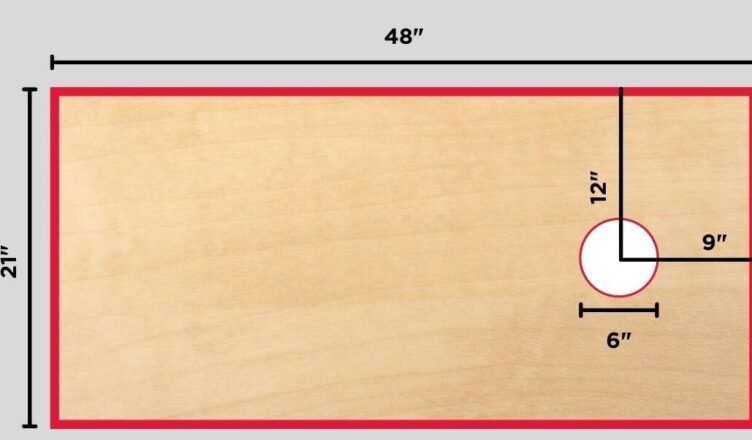
Board surface: 48 inches long × 24 inches wide (4 feet × 2 feet)
Board thickness: Minimum ½ inch plywood
Hole diameter: 6 inches
Hole placement: Center of hole is 9 inches from the top edge and 12 inches from each side edge
Front height: 3 to 4 inches from the ground
Back height: 12 inches from the ground
Board angle: Approximately 10 degrees
Distance between boards: 27 feet (front edge to front edge)
That’s the quick reference. Now let’s break each one down so you understand why these numbers matter and how to measure them correctly.
Board Size: 4 Feet × 2 Feet
The playing surface of a regulation cornhole board measures 47½ to 48 inches long by 23½ to 24 inches wide. You’ll see both the exact numbers and the rounded 4′ × 2′ used interchangeably — either is acceptable for regulation play.
The surface must be smooth plywood at least ½ inch thick. ACA-sanctioned tournaments require wooden boards specifically, since plastic and composite surfaces play differently — bags slide at different speeds, and the overall game feel changes significantly.
Most serious players and manufacturers use ¾-inch plywood because it’s sturdier and gives a more consistent playing surface. The extra thickness adds weight but reduces warping over time, which is a real issue with thinner boards that get left outdoors.
I’m a fan of Kreg tools! They are kind enough to provide a free set of cornhole plans!
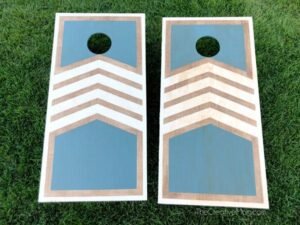
Why this size matters: The 4′ × 2′ dimensions create the right balance of target area. The board is large enough to land bags on but small enough that precision matters. If you’re building your own boards, get this measurement right first — everything else (hole placement, leg height) is calculated relative to the board edges.
Hole Size and Placement
The hole is where the magic happens — literally, since sinking a bag through the hole scores 3 points versus 1 point for landing on the board.
Hole diameter: 6 inches (with a tolerance of ± ¼ inch)
Center of hole from the top edge: 9 inches (± ¼ inch)
Center of hole from each side edge: 12 inches (± ¼ inch)
Since the board is 24 inches wide and the hole center is 12 inches from each side, the hole is perfectly centered left to right. It sits in the upper third of the board, which creates the familiar cornhole layout most people recognize.
A 6-inch hole might sound generous, but remember that regulation bags are also 6 inches square. A bag has to be oriented just right or it’ll catch the rim. This is by design — the game would be too easy with a larger hole and too frustrating with a smaller one.
If you’re building boards: Mark the hole center at 9 inches down from the top and 12 inches from the side. Use a compass or a pencil tied to a string to draw a 6-inch diameter circle (3-inch radius from center). A 6-inch hole saw makes the cleanest cut, but you can also drill a starter hole inside the circle and cut with a jigsaw. Place painter’s tape over your cut line to prevent tear-out in the plywood.
Board Height and Angle
Cornhole boards aren’t flat on the ground — they sit at an angle, with the back (top) end higher than the front (bottom) end.
Front height: 3 to 4 inches from the ground to the top of the playing surface
Back height: 12 inches from the ground to the top of the playing surface
Resulting angle: Approximately 10 degrees
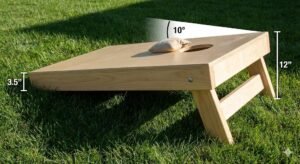
This angle is critical to how the game plays. It gives thrown bags a natural tendency to slide toward the hole rather than just sitting where they land. The angle also makes the hole visible from the throwing position 27 feet away.
The front of the board should sit at roughly a 90-degree angle to the playing surface — meaning the front edge is vertical, not angled. Same with the back. Both ends should form clean right angles with the board face. This prevents bags from getting stuck under the board edges.
Most regulation boards use folding legs attached at the back of the board. The legs swing out to create the 12-inch rear height and fold flat for storage and transport. If you’re building boards, the legs should be sturdy enough that the board doesn’t wobble or shift during play — a board that moves when a bag lands is no fun for anyone.
Distance Between Boards: 27 Feet
This is the measurement that catches most casual players off guard. Twenty-seven feet is a long way to throw a one-pound bag accurately.
Regulation adult distance: 27 feet, measured from the front edge of one board to the front edge of the other board
Junior distance (12 and under): 12 to 15 feet between front edges
Senior/impaired distance: 12 to 15 feet (by agreement of all players)
Note that the distance is measured front edge to front edge — not from hole to hole. Since the holes are offset 9 inches from the top and the boards are 4 feet long, the actual distance between the two holes is about 33 feet.
Measuring tip: The easiest way to set up 27 feet is to use a tape measure or a piece of string cut to length. If you don’t have a tape measure handy, 27 feet is 9 yards — roughly the width of a standard residential street. Some players mark their throwing distance on a rope or cord that they bring to every game for quick and consistent setup.
For casual backyard play: Many players set boards at 24 feet apart, which is the informal “backyard distance.” There’s nothing wrong with this — it makes the game slightly easier and works well when you’re playing with kids or mixed skill levels. But if you want to practice for league or tournament play, train at the full 27 feet.
Court Dimensions
A full cornhole court includes more than just the two boards. Here’s the complete layout:
Court size: 8 to 12 feet wide by 40 to 45 feet long
Pitcher’s box: 4 feet deep × 3 feet wide, located on each side of each board (4 boxes total)
Foul line: The front edge of each board
The pitcher’s box is where you stand when you throw. Each board has two boxes — one on each side — so you can throw from whichever side you prefer. You must stay in the same box for an entire inning, but you can switch sides between innings.
The foul line is simply the front edge of the board nearest to you. Your feet must stay behind this line when you release the bag. Stepping on or over the foul line while throwing is a foul, and the bag is removed from play.
Setting up multiple courts: If you’re running a tournament or just have multiple games going at a party, courts should be at least 10 feet apart. The ACA recommends 12 feet between adjacent courts for comfortable play. This spacing accounts for the pitcher’s boxes on both sides of each board and gives players room to move without bumping into the game next door.
Indoor play: If you’re playing indoors, you need a minimum of 12 feet of vertical clearance above the court. Most standard ceilings are 8 to 9 feet, which means you’ll need a gym, warehouse, or similar space for a proper indoor court. Lower ceilings force players into flatter throws that change the game significantly.
Bag Dimensions (Quick Reference)
Since you’re already here looking up dimensions, here are the official bag specs too:
Bag size: 6 inches × 6 inches (made from 6¼ × 6¼ inch fabric squares with ¼-inch seams)
Bag weight: 14 to 16 ounces (most tournament bags target 15.5 to 16 oz)
Bag thickness: Approximately 1 inch when lying flat
Fill material: Plastic resin pellets or corn feed (resin is now standard for all-weather play)
Each player uses 4 bags of the same color or design. Both players’ bags must be visually distinct from each other so scoring is clear.
For a complete breakdown of bag types, fills, and our top picks, check out our Best Cornhole Bags guide.
Regulation vs. Tailgate Size Boards
Not all cornhole boards are regulation size. You’ll often see smaller “tailgate” or “travel” sets sold at sporting goods stores. Here’s how they compare:
Regulation: 48″ × 24″ (4′ × 2′) — This is the official tournament size and what we recommend for the best playing experience. These boards are heavier (25+ pounds each) but play exactly like what you’ll find at any organized event.
Tailgate/Travel: Typically 36″ × 24″ (3′ × 2′) — These boards are one foot shorter, making them lighter and easier to transport. They fit in a car more easily and work fine for casual play. However, the shorter length changes the hole position and reduces the playing surface, making the game feel noticeably different.
Junior/Mini: Various smaller sizes — These are designed for young children and are more toy than sport. Fine for kids under 6 or 7, but older kids will outgrow them quickly.
If you’re buying boards and have the space to store regulation size, go regulation. The playing experience is noticeably better, and you won’t need to upgrade later when you start playing more seriously. Check out our Best Cornhole Sets guide for our top picks at every price point.
Common Setup Mistakes
Even experienced players sometimes get the setup wrong. Here are the most common issues:
Boards too close together. This is the #1 mistake in casual play. People set boards 15 to 20 feet apart because 27 feet looks intimidatingly far. The problem is that shorter distances reward power over finesse and don’t prepare you for playing on a properly set up court. Use a tape measure and set them at 27 feet — you’ll adjust faster than you think.
Hole in the wrong spot. Some cheaper boards place the hole dead center or at a slightly different offset. The regulation placement (9 inches from the top, 12 inches from each side) is designed to create the right balance of challenge. If your boards have off-center holes, the game will feel different from what you see at tournaments and organized events.
Uneven ground. Cornhole should be played on level ground. A board sitting on a slope will cause bags to slide unpredictably and makes the game unfair for whoever is throwing uphill. If your yard has a slope, orient the boards so the slope runs side to side (perpendicular to the throwing line) rather than front to back.
Boards pointing the wrong direction. In outdoor play, try to avoid aligning your court east to west. Players throwing into the setting sun have a real disadvantage. North-south alignment or a shaded area works best.
No consistent setup. If you play regularly, set up the same way every time. Using the same distance and orientation helps you develop muscle memory and actually improve your game over time. Constantly changing the setup makes it hard to build consistency in your throws.
Quick Reference Printout
Save this for your next game or board-building project:
| Dimension | Measurement |
|---|---|
| Board length | 48 inches (4 feet) |
| Board width | 24 inches (2 feet) |
| Board thickness | ½ inch minimum plywood |
| Hole diameter | 6 inches |
| Hole from top edge | 9 inches (to center) |
| Hole from side edges | 12 inches (to center) |
| Front height | 3–4 inches |
| Back height | 12 inches |
| Board angle | ~10 degrees |
| Distance between boards | 27 feet (front to front) |
| Distance between holes | ~33 feet |
| Pitcher’s box | 4 ft × 3 ft |
| Court size | 8–12 ft wide × 40–45 ft long |
| Bag size | 6″ × 6″ |
| Bag weight | 14–16 ounces |
| Junior distance | 12–15 feet |
Frequently Asked Questions
What is the official distance between cornhole boards? The regulation distance is 27 feet, measured from the front edge of one board to the front edge of the other. For junior players (12 and under), the distance is reduced to 12 to 15 feet.
What size is a regulation cornhole board? A regulation cornhole board measures 48 inches long by 24 inches wide (4 feet by 2 feet), made from plywood at least ½ inch thick. The back of the board sits 12 inches off the ground, creating roughly a 10-degree angle.
How big is the hole in a cornhole board? The hole is 6 inches in diameter. Its center is positioned 9 inches from the top edge of the board and 12 inches from each side, placing it perfectly centered left to right in the upper portion of the board.
What’s the difference between regulation and tailgate cornhole boards? Regulation boards measure 4 feet by 2 feet (48″ × 24″). Tailgate or travel boards are typically 3 feet by 2 feet (36″ × 24″), making them shorter, lighter, and easier to transport but changing the playing experience. Tournament play requires regulation-size boards.
Can you adjust the distance between cornhole boards? For casual play, you can set boards at whatever distance feels fun. Many backyard players use 24 feet instead of the full 27. For junior players, 12 to 15 feet is standard. In any organized competition, boards must be set at the regulation 27 feet.
What kind of wood should cornhole boards be made from? Regulation boards must be made from smooth plywood. Most builders use ½-inch to ¾-inch birch or sanded pine plywood. The surface should be smooth enough for bags to slide but not so slick that they fly off the board. A semi-gloss paint or polyurethane finish is typically applied for consistent slide.
Sources: American Cornhole Association (ACA), American Cornhole Organization (ACO), American Cornhole League (ACL). All dimensions reflect current official regulations as of 2025.
Thinking about buying regulation boards? Check out our guide to the Best Cornhole Sets for 2025.